A Song of Love
An all-ages song about helping to heal an injured bird and then... letting go
Music by Ron KlusmeierWords by Walter Farquharson
Tune Name: CARLYLE
Lyrics as Poetry
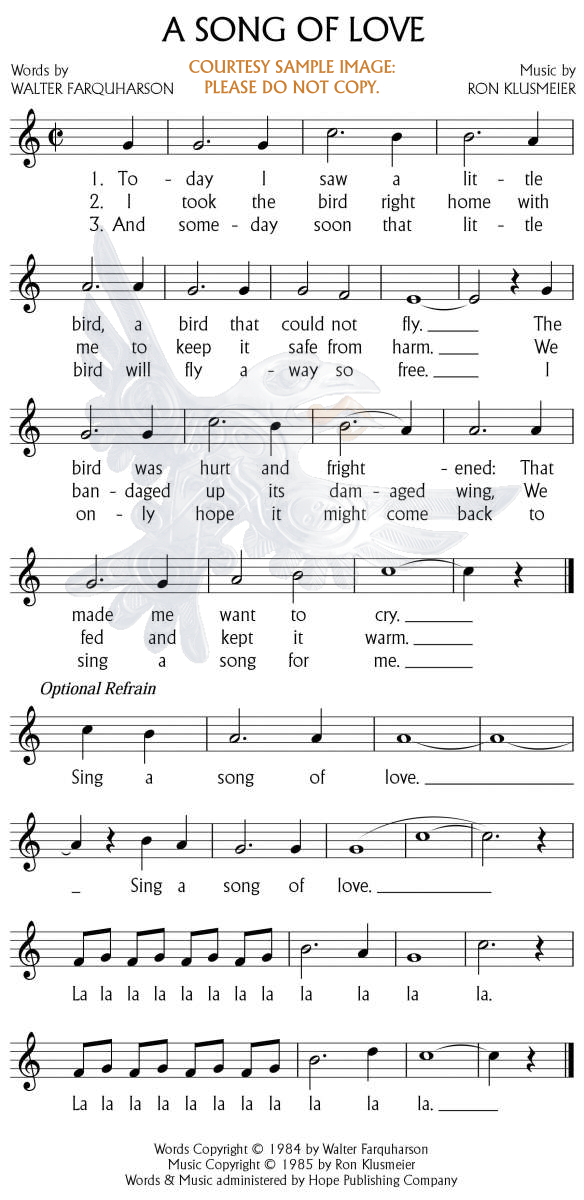
Today I saw a little bird,
a bird that could not fly.
The bird was hurt and frightened:
That made me want to cry.I took the bird right home with me
to keep it safe from harm.
We bandaged up its damaged wing.
We fed and kept it warm.And someday soon that little bird
will fly away so free.
I only hope it might come back
to sing a song for me.
Words by
Walter FarquharsonCopyright © 1984 by Walter Farquharson
Administered by Hope Publishing Company
Carol Stream, Illinois • USA
Audio Sample for
"A Song of Love"
One verse + optional refrain
played on piano
Scripture References
- Psalm 68:5-6
- Psalm 84:3
- Matthew 6:25
- Matthew 25:34-40
- Luke 12:24
Season, Theme
or Subject
- All-ages
- Care, Caring
- Children∶ music about
- Children∶ music for
- Compassion
- Heal, Healing
- Intergenerational
- Letting Go
Presentation Suggestions
Not yet available for this title. Contact us if you are a subscriber (or purchaser of this title) and need this item.
Projection Images
This feature is only accessible to Subscribers or those who have purchased this Single Title.
Use the link below for instructions on how to use the Projection Images in Powerpoint and Keynote.
Learn moreProjection Images
Available for This Title
16:9 Words Only
16:9 Words With Music
16:9 Words With Images
4:3 Words Only
4:3 Words With Music
4:3 Words With Images
Accompaniment Recordings
Not yet available for this title. Contact us if you are a subscriber (or purchaser of this title) and need this item.
-
Subscribe To All Titles
unlimited annual access to everything on this site
-
Purchase
This Title
unlimited access to all versions of this title
-
unlimited access to an individual version of this title
Purchasers and Subscribers
Click links below to download your versions.
Versions Available for This Title
Melody Line Versions (includes transposing instruments)
-
Melody Line: LARGE PRINT
-
Melody Line: 'C' Instrument or Vocal
-
Melody Line: 'C' Instrument 8va
-
Melody Line: Alto Clef Instrument
-
Melody Line: Bass Clef 'C' Instrument
-
Melody Line: ‘Bb’ Instrument
-
Melody Line: ‘Eb’ Instrument
-
Melody Line: ‘F’ Instrument (high)
-
Melody Line: ‘F’ Instrument (low)
Bulletin Masters
-
Bulletin Master: Letter-size 1-up
-
Bulletin Master: Letter-size 2-up
-
Bulletin Master: Legal-size 1-up
-
Bulletin Master: Legal-size 2-up
Piano Versions
Hymn-style Vocal Harmonizations (accompany with any piano versions)
-
Hymn-style: SATB voices
Guitar Chords & Bass Progressions
-
Guitar & Bass: Full chords in keyboard key
-
Easy Guitar: Basic chords
Comments About Song
WHEN USING THE ROYALTY-FREE RESOURCES
IN THIS SECTION, PLEASE CREDIT THE AUTHOR.
A Reflection by
WALTER FARQUHARSON
Jesus had a particular concern for the hurting creatures and people of the world. With that thought in mind, this song celebrates not only the matter of being willing to help those who are vulnerable and in need, but also the offering of freedom as a gift for the ones who have been helped.
A child will usually respond with sympathy upon seeing or hearing about an injured bird or a stray kitten. However, prejudices implanted early in children’s minds may diminish compassion toward people who are hurting. We have subtle but cruel ways of judging or ‘putting down’ others — “She’s only a bag lady”, or “His parents are just migrant workers”.
We should seek to help one another not in order to foster restraint or dependency, but so that healing, wholeness, and freedom might result. It is good to feed the hungry, but also necessary to help them find or regain ways of feeding themselves. No one — not a child, a sick person, a poor person, or an old person — wants to be just a receiver. Therefore, we must learn to let others give of themselves, choose for themselves, and participate freely as partners in God’s good work.
In this song, we anticipate the bird coming back to sing a song, not only for us, but with us. After we have helped to heal it (bandaged, fed, and kept it warm), we must offer freedom (let the bird go) and hope our act of caring will be remembered, (“I only hope it might come back to sing a song with me.”). These same rules can also apply to God’s human creatures.